Auf den Stuhl, auf den Tisch
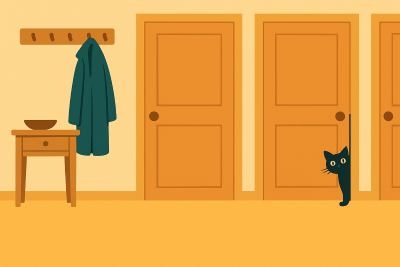
Ermanno told his story.
A man comes home and finds three doors instead of the usual two.
He cannot explain this change.
Then a black cat comes out of the third door.
It is the cat from his childhood.
So the third door is the gateway back to childhood, to true paradise.
Oliver: Das ist die Antwort auf die Frage: Wohin führt die dritte Tür.
Elisa: Sag! Die dritte Tür führt …
Ermanno: Ins Paradies.
Elisa: In die Kindheit. Ins wahre Paradies.
Frau Mutter: Seht! Oreste ist noch ein Kind!
Oreste beginnt zu klettern und zu springen.
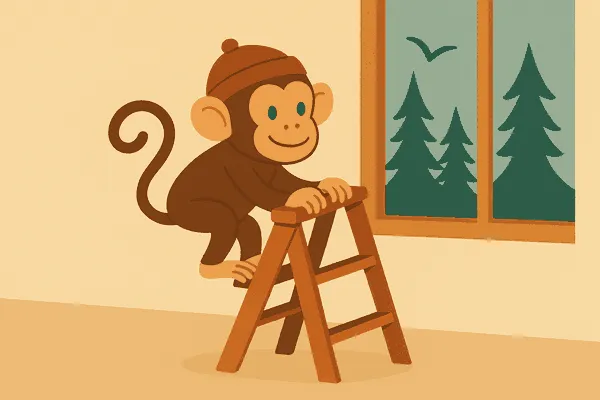
Oreste springt auf …!
-
auf den Stuhl (chair)
-
auf das Klavier (piano)
-
auf den Tisch (table)
-
auf den Tresen (counter)
-
auf den Sessel (armchair)
-
auf den Teppich (carpet)
-
auf das Bett (bed)
-
auf den Koffer (suitcase)
-
auf die Theke (bar counter)
-
auf das Regal (shelf)
-
auf die Zeitung (newspaper)
-
auf den Balkon (balcony)
-
auf den Kopf (head!)

Grammar focus: “auf” + accusative
When Oreste moves onto something, we ask: Wohin springt Oreste?
For the answer we need “auf” + accusative.
Examples:
Rule: auf + Akkusativ = onto / on to (with movement).
Oliver's Homework
Write the questions and the answers. Repeat with each item from the list.
Ermanno's Homework
Ermanno wants to stop him.
Use the imperative form:
Examples:
-
Oreste, spring nicht auf den Stuhl!
-
Spring nicht auf das Klavier!
-
Spring nicht auf den Kopf!
Try with all the other objects.
Zampettone's Wordflock